
Checking for a Warrant in Mesa County
A good Mesa County warrant lookup begins with one question: who issued or recorded the process? The Colorado Judicial docket search can point you toward a likely state-court case, though it is not a direct warrant-status database. The Mesa County Combined Court confirms district and county court matters. The Mesa County Sheriff's Office Records Unit handles agency records and offers an active-warrant-check option on its signed request form. City courts stay separate. Before any inquiry, gather a legal name, other names used, date of birth, and any case or citation number. Share sensitive details only through the official channel that needs them. If a Mesa County warrant record may be active, a lawyer can help plan the safest response before an in-person visit.
- Identify the court or agency most likely to hold the record.
- Use the state docket as a lead for district or county court cases.
- Ask the Combined Court or named city clerk to confirm the case.
- Submit the signed MCSO form for an agency-specific check.
- Discuss an active result with counsel and follow the issuing court's directions.
Mesa County Layered Warrant System
Mesa County warrant records sit in layers. The Colorado District Court and County Court in the 21st Judicial District keep state-court case files. Municipal courts hold city ordinance, traffic, and failure-to-appear matters. The sheriff's office keeps reports, arrest records, custody information, and its own warrant-check responses. Federal matters stay in federal systems even if a person later lands in the county jail. Because of that structure, a clear answer from one office does not clear every possible source. Start with the incident, summons, or court named on your papers. Then ask that office for a current status. When the source is unclear, the Combined Court and the sheriff's Records Unit are distinct starting points, not interchangeable counters.
Mesa County Warrant Types
The reason for issuance shapes both the record and your next step. Colorado sources use arrest warrant, bench warrant, failure-to-appear warrant, and, in Grand Junction traffic matters, outstanding judgment warrant or OJW. They do not support calling every local process a capias.
| Warrant Type | How It Arises | Who Issues It |
|---|---|---|
| Arrest warrant | A sworn application supports arrest authority | A judge |
| Bench warrant | A missed date or failure to comply | The assigned court |
| Search warrant | Judicial approval authorizes a search | A judge |
| FTA or OJW | A missed appearance or order in the local process | State or municipal court |
A Mesa County search warrant authorizes a search, not an arrest roster entry. Access to arrest and search warrants or affidavits may also be limited before execution.
Two Mesa County Warrant Record Counters
The Mesa County Sheriff's Office and the Justice Center sit close together in Grand Junction, but they fill different record roles. MCSO Records, at 215 Rice Street, handles sheriff records, agency checks, and certain bond or warrant payments. The Mesa County Justice Center, at 125 N Spruce Street, houses the Combined Court, which answers district and county questions about cases, dockets, court orders, and appearances. Going to the wrong counter can produce a correct "not our record" reply. That reply does not prove no Mesa County warrant exists. Ask who issued the process, and whether you need a court file, an agency record, or custody information. The official sheriff page identifies the agency and its public service routes.
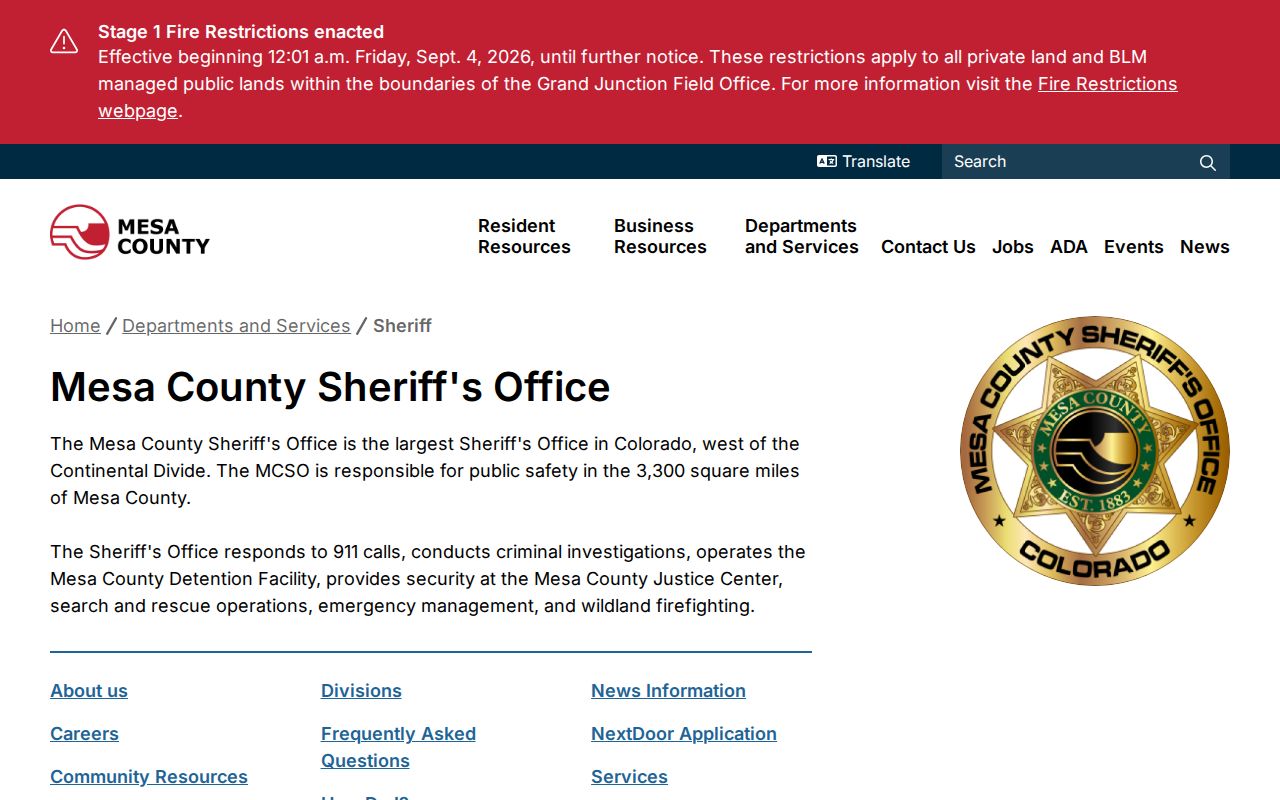
The sheriff's organization separates its own services from the court clerk's work. The sheriff divisions page also shows where Support Services and Records sit within MCSO.
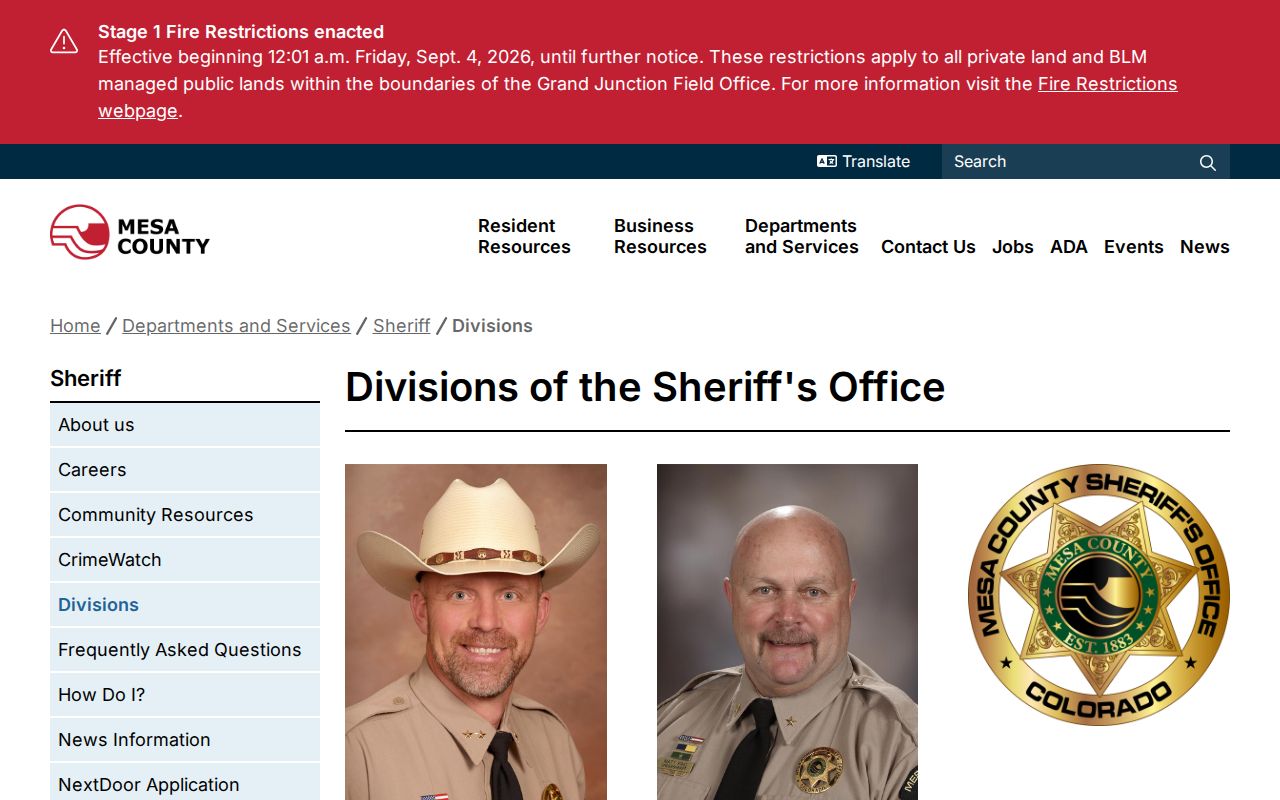
That structure explains why agency record checks go to Records while the Combined Court keeps the Mesa County court file.
Inside a Mesa County Warrant Record
A Mesa County warrant record might be the order itself, the application, an affidavit, a docket event, a return of service, an agency confirmation, or a bond entry. Public fields vary with the record holder and access rules. A docket can lead you to a case without showing a live warrant flag.
| Warrant or Case Number | An identifier such as 2026-CR-01234; format varies by court |
|---|---|
| Subject | The identifying name associated with the official record |
| Charge or Matter | The alleged offense, ordinance, or compliance issue if public |
| Issuing Court | The court that controls confirmation and next steps |
| Bond | Terms appear only after a judge sets them |
| Status | Active, served, recalled, quashed, or restricted when available |
Use the case number and court name to seek official confirmation. Never treat an old screen capture as current proof of a Mesa County warrant.
MCSO Warrant Check Scope
The strongest sheriff tool is the signed MCSO Open Records Form. Its active warrant check asks for a name, date of birth, and every name used. The response states either no record or a record of arrest and/or active warrant "with this agency." Those last words set the limit. An MCSO result does not certify every state, municipal, federal, or outside-agency system. Submit the form by email to so-records@mesacounty.us, by mail, or at the Records counter with photo identification and a signature. Records can be reached at 970-244-3500, option 2. The lobby lists weekday hours of 7 a.m. to 4 p.m., excluding holidays. The Records Unit service block gives current request and fee context.
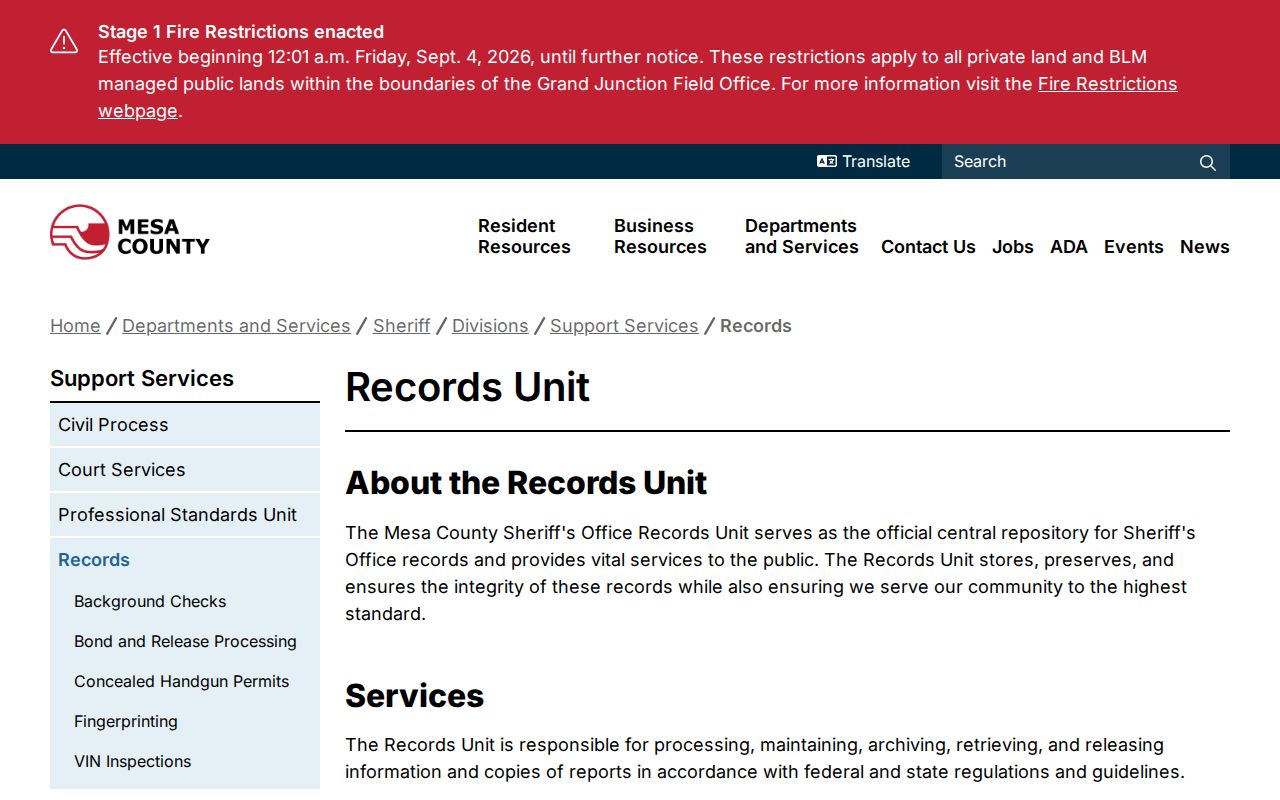
Current official pages control when an older fee sheet differs. The open-records instructions show the email, mail, and counter routes for Mesa County requests.
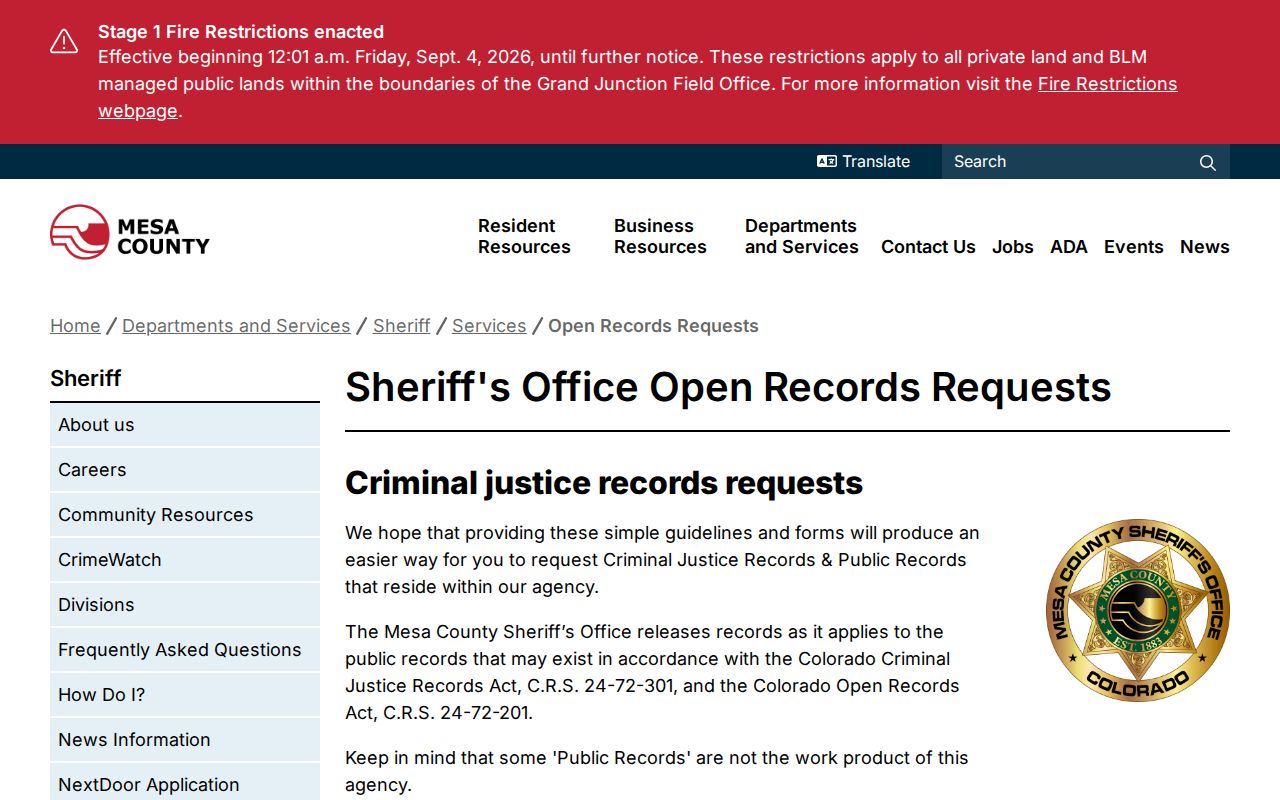
The channel list confirms that a signed form and photo identification remain part of the MCSO request process in Mesa County.
Issuing and Serving Warrants in Mesa County
Courts issue Mesa County warrants. Law enforcement serves them. The Colorado District Court, County Court, and municipal courts each act within their jurisdiction. MCSO handles county law operations, court security and transport, records, and detention, while city police or a town marshal may serve local process. Federal agencies handle federal warrants.
The basic path is: sworn application or missed court duty → judicial order → entry with the proper court or agency → service or recall → return to the issuing court. Each arrow may create a different record. This is why the issuing court remains the best place to confirm what action is required.
MCSO Records Unit
215 Rice Street
Grand Junction, CO 81501
970-244-3500, option 2
Blotter Is Not a Warrant List
Two popular tools answer the wrong question. The MCSO blotter collects recent bookings and daily activity, and its public report window covers just 30 days. A blank result proves nothing. It does not show that no warrant exists. The inmate locator answers a separate question: whether someone sits in custody right now. Bond details may not appear until a judge sets them. Neither tool lists Mesa County outstanding warrants. For a real warrant check in Mesa County, call the issuing court or use the MCSO request form rather than inferring status from either one.
If You Have a Warrant in Mesa County
Start by confirming the warrant with the court or agency that issued it. Ask the right questions early. Which court issued it? Find out whether an appearance is required, what identification is needed, and whether bond or another option exists. Ask how to get a receipt and a new court date. Staff at a Mesa County court can explain procedure, but they cannot give personal legal advice. MCSO describes four bond routes. Cash requires the full amount through the proper channel. A surety bond uses a licensed bondsman, a property bond runs through the 21st Judicial District court clerk, and a personal-recognizance bond is a promise to appear without money, subject to court terms. None is guaranteed in a specific Mesa County case.
Important: Speak with an attorney before surrendering or appearing because an active Mesa County warrant can lead to arrest.
Keep every receipt and each new court date. Payment alone does not recall a Mesa County warrant unless the court takes the required action.
Mesa County Bond Routes
The MCSO bond page keeps payment and release work separate from court confirmation. One number handles remote cash-bond questions. Call 970-244-3960 at any time for payment questions only. Booking staff confirms the amount and explains how to pay. During regular hours, processing runs through Records; after hours, the detention lobby intercom is the contact point. Mesa County policy calls for an initial hearing as soon as possible, ordinarily within 48 hours after arrival, subject to stated exceptions. A judge still has to set bond. Posting one also creates a duty to appear. Before sending funds to anyone in Mesa County, confirm the amount and the accepted method for that specific case.
Mesa County Warrant Records and Public Access
Who holds the record decides access to Mesa County warrant files. The Colorado Open Records Act covers government records in general. The Colorado Criminal Justice Records Act governs sheriff criminal-justice records. Court access follows Colorado Judicial Branch policy, including CJD 05-01. Juvenile, sealed, open-case, medical, victim, and protected law-enforcement information can be withheld or redacted.
Key Rules:
C.R.S. 24-72-201 sets the general CORA policy, subject to exceptions and the correct custodian.
C.R.S. 24-72-301 frames access to criminal-justice records held by MCSO.
C.R.S. 16-1-106 addresses sworn warrant applications and electronic procedures.
C.R.S. 19-1-304 places special limits on juvenile-record access.
A CORA request sent to Mesa County cannot pull criminal court files. The county is not the custodian of those. Route such requests to the court itself.
Mesa County Docket Limits
Colorado's public docket lets you search by district, county, courthouse, court type, division, date, case number, party, attorney, or bar number. It works best when you already know some case details. The judicial access guide carries a warning, though. Online information is not the official record. Cases, case types, and data can be missing. Treat a docket hit as a starting point. Use it to identify the court and the case number. Then confirm with the Mesa County Combined Court at 970-257-3640 or mesa.court@judicial.state.co.us. Court documents go through MesaCourtDocuments@judicial.state.co.us. Division assignments shift, including after the fourth county judgeship took effect in 2026, so confirm the current division in Mesa County rather than trusting an old directory.
Mesa County Warrant Terms
Names matter in a records search. Local terms tell you what a record is and which Mesa County office controls it. A few short definitions keep a warrant search from turning into the wrong kind of request.
- Bench warrant
- A judge's order often tied to a missed appearance or failure to comply.
- OJW
- Grand Junction's term for an outstanding judgment warrant in its traffic-infraction process.
- Recall or quash
- A court action that withdraws or sets aside its warrant.
- PR bond
- A release promise to appear without a cash payment, subject to conditions.
- Return of service
- A record of execution or attempted execution of process.
A search result cannot settle it. In Mesa County, only the issuing court can recall or quash a warrant.
Municipal Mesa Warrant Routes
Municipal matters belong to the city court that issued them. Grand Junction gives residents a citation and case portal plus a written warrant-clearing guide, yet that portal is no full warrant roster. Fruita points court questions to its clerk and notes that some police summonses land in Mesa County Court. Palisade posts a monthly court schedule and a payment portal. That portal may take 48 hours after sentencing to update. De Beque publishes official court, marshal, and records links with no visible public roster. So read the citation or summons first. It often names the right court. Collbran has an MCSO services agreement, but that agreement does not prove who keeps a town court record. Ask the town and MCSO which office in Mesa County holds the specific material.
Mesa County Request Checklist
An MCSO records request needs detail. Give enough to find the agency record. The signed Mesa County form asks for the requester, the desired record, and the subject identifiers needed for the chosen service.
- Use every legal, married, maiden, or alias name that applies to your own record.
- Give the date of birth through the secure official form.
- State the date range and the type of record sought.
- Choose email, mail, or in-person delivery as the office allows.
- Keep the response date, custodian name, and any case number.
Large requests may require a deposit. A Mesa County response can also be partial or redacted under CJRA, another statute, or a court order.
Mesa County Warrants by City
In Mesa County, city police and municipal courts handle local ordinance, traffic, and failure-to-appear matters. State courts keep their own dockets. The sheriff does too. These five incorporated places follow the 2020 Census ranking.
Grand Junction Warrant Records
65,560 · Municipal court portal, clerk, and police records routes
Fruita Warrant Records
13,395 · City court and county-court summons routing
Palisade Warrant Records
2,565 · Monthly municipal court and town records custodian
De Beque Warrant Records
493 · Town court, marshal, and public-record links
Collbran Warrant Records
369 · Town inquiry and contracted MCSO service route
A city portal hit is one lead. Confirm any Mesa County warrant with the court or agency that owns the record.